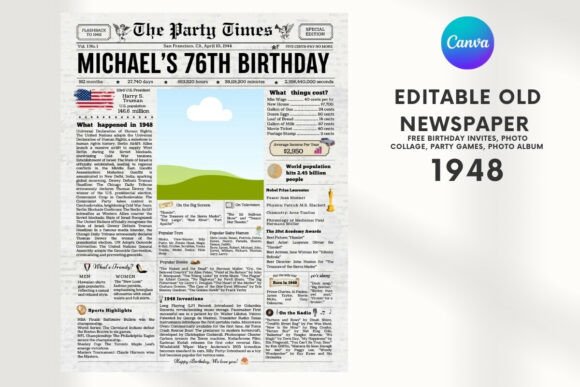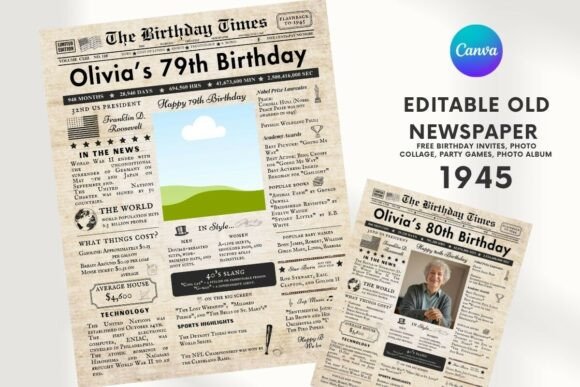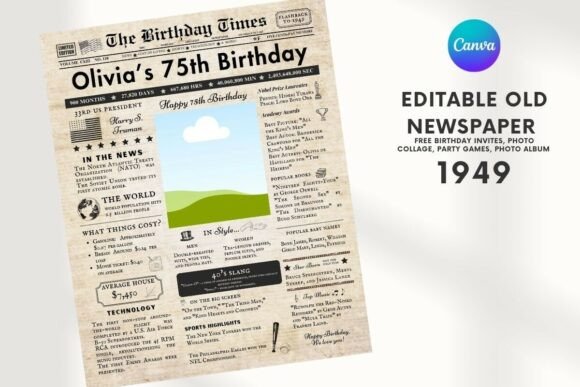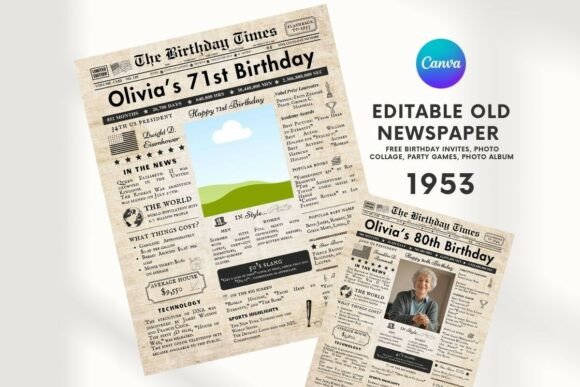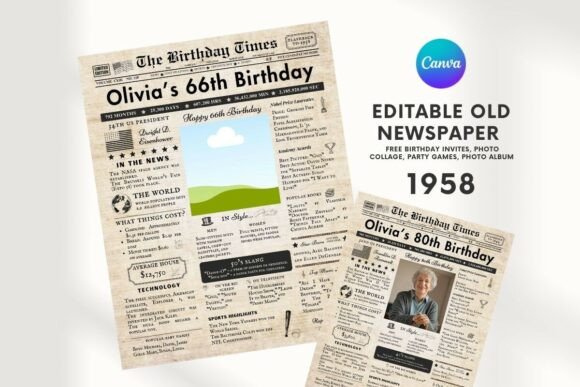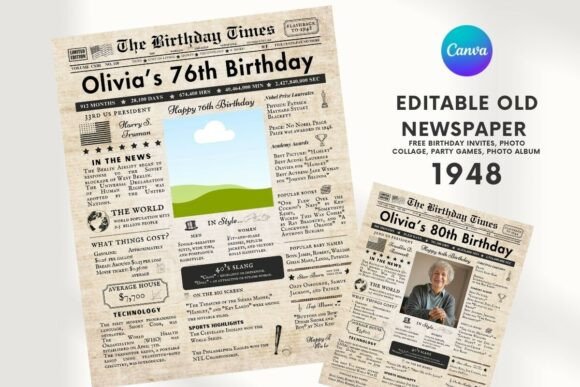
EDITABLE 76 Birthday Newspaper
Turning 76 isn’t just another year—it’s a quiet landmark. A lifetime of choices, relationships, resilience, and small joys distilled into decades. Yet many birthday celebrations still rely on predictable formats: standard invites, generic cards, or digital posts that vanish in a scroll. That’s where the EDITABLE 76 Birthday Newspaper stands apart—not as novelty, but as intentionality made tangible. Designed for Canva, this template transforms how we honor longevity, legacy, and lived experience. It’s not about age; it’s about attention. Giving someone a newspaper dedicated entirely to their story signals: You matter. Your journey matters. We’ve taken time to notice.
Why a Newspaper Format Resonates—Especially at 76
Newspapers carry cultural weight: authority, curation, permanence. Unlike social media feeds—ephemeral and algorithm-driven—a printed newspaper feels deliberate and archival. For someone celebrating their 76th birthday, that resonance deepens. Many grew up with physical papers delivered daily—reading headlines, scanning obituaries, circling recipes, saving clippings. Reintroducing that format taps into sensory memory: the rustle of newsprint, the layout rhythm of columns and bylines, the gravitas of a “front page” headlined with their name.
This isn’t retro for retro’s sake. It’s psychological alignment—matching form to meaning. A milestone like 76 invites reflection, not just celebration. The newspaper structure supports that naturally: a “Life in Review” section for key milestones, a “Fun Facts” sidebar (e.g., “First car: 1968 Ford Falcon,” “Visited 12 countries before retirement”), an “Editorial Tribute” written by family or friends, even a playful “Weather Report” (“Sunny skies, occasional laughter showers, high chance of nostalgia”). Each element serves narrative—not decoration.
How Modern Workflows Make This Template Practical—Not Just Pretty
Canva’s ecosystem is no longer just for designers. It’s where teachers draft lesson plans, freelancers build pitch decks, small business owners design Instagram carousels, and grandparents craft holiday newsletters. The EDITABLE 76 Birthday Newspaper meets users where they already are: in a browser, on a laptop or tablet, without needing InDesign skills or print-shop appointments.
What makes it genuinely usable? Three things:
- True editability: Every headline, photo placeholder, date, quote, and column width is adjustable—not locked behind layers or static PDFs.
- Print-ready flexibility: Optimized for home printers (letter/A4) and professional print shops (CMYK, bleed marks, high-res export), so users choose convenience or quality without compromise.
- Time-aware scaffolding: Sections are labeled intuitively (“Childhood Years,” “Career Highlights,” “Family Tree Snapshot”)—not blank canvases. That lowers cognitive load, especially for busy adult children planning a surprise or educators organizing intergenerational projects.
One freelance graphic designer in Portland used the template to create a birthday newspaper for her father’s 76th—then adapted the same layout into a mini-zine for his retirement party. Another educator in Toronto printed copies for her 76-year-old mentor’s classroom farewell, letting students contribute short “letters to the editor” about what they’d learned from him. These aren’t edge cases—they reflect how adaptable tools meet real human rhythms.
Nostalgia, Yes—but Not at the Expense of Authenticity
“Nostalgia” is often misused as shorthand for aesthetic mimicry—sepia filters, faux-vintage fonts, grainy textures. The EDITABLE 76 Birthday Newspaper avoids that trap. Its nostalgic power comes from structure and sincerity, not surface-level styling. You can use clean sans-serif typefaces and full-color photos if that reflects the celebrant’s personality. Or go monochrome with serif headings if that suits their love of classic journalism. The template enables voice—not imposes it.
This matters because authenticity builds connection. A 76-year-old veteran might appreciate a “Front Page” styled like a 1950s broadsheet—with references to historic events he lived through. But a retired software engineer who helped build early internet infrastructure might prefer a sleek, data-informed layout: timelines visualizing tech evolution alongside personal career milestones. The template accommodates both—not by being “vintage” or “modern,” but by being responsive.
More Than a Party Prop—A Bridge Across Generations
In an era of fragmented attention and shrinking shared rituals, the newspaper becomes a rare physical artifact that invites slow engagement. At a 76th birthday gathering, guests don’t just glance and move on. They sit. They read aloud. They point to photos and say, “I remember when…” Grandchildren ask questions about the “Obituaries” section (reimagined as “People Who Shaped Their Life”) or trace the map in the “Travel Edition” insert.
This isn’t passive decoration. It’s participatory storytelling. One family in Austin assigned each relative a section to research and write—granddaughter handled “Music Through the Decades,” son-in-law compiled “Favorite Recipes Over 50 Years,” spouse penned the “Editorial.” The process became part of the celebration, deepening bonds before the party even began.
Realistic Use Cases Beyond Birthdays
While designed for milestone birthdays, the framework extends naturally:
- Retirement tributes: Replace “Birthday Edition” with “Final Shift Edition,” highlighting career impact and peer testimonials.
- Anniversary commemorations: “76 Years of Marriage” edition—blending love letters, shared travel, and family milestones.
- Educational projects: History classes researching local figures or students documenting elders’ oral histories using the newspaper as output format.
- Community archives: Neighborhood associations creating “Our Block, 1948–2024” editions to preserve local memory.
None require design expertise—just curiosity, care, and access to Canva. That accessibility is key. It democratizes meaningful commemoration: no budget too small, no skill set too narrow, no timeline too tight.
What This Says About Where We’re Headed
We’re moving away from transactional gestures—“liked” posts, mass-produced cards—and toward curated, contextual acts of recognition. People aren’t rejecting digital tools; they’re demanding that those tools serve deeper human needs: continuity, dignity, remembrance. The rise of printable, editable templates like the EDITABLE 76 Birthday Newspaper reflects that shift—not as a trend, but as a quiet recalibration.
It also mirrors broader preferences in communication: clarity over clutter, substance over speed, permanence over disposability. In a world where attention is scarce and memory feels increasingly fragile, choosing to make something tangible—something that can be held, saved, reread—is itself an act of resistance and reverence.
So whether you’re planning for a parent, a mentor, a colleague, or yourself, consider what a newspaper says before a single word is written: This life has been observed. This story has been gathered. This person is known. That’s not just thoughtful design—it’s humane design. And it starts with one editable, adaptable, deeply intentional template.