New Orleans Skyline Icon Set: Minimalist City Silhouettes for Real-World Design
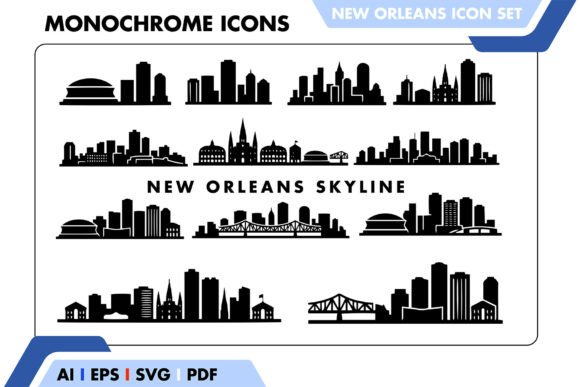
When you need a visual shorthand for New Orleans—one that’s instantly recognizable, endlessly adaptable, and effortlessly professional—the New Orleans Skyline Icon Set delivers with quiet confidence. This isn’t just another collection of clipart-style cityscapes. It’s a thoughtfully curated set of 15 distinct skyline variations, each distilled into a clean, bold black-and-white silhouette. Designed for clarity over clutter, it speaks the language of modern design: simplicity, scalability, and intention.
What Makes This Set Stand Out?
At its core, the New Orleans Skyline Icon Set embraces minimalism not as a trend—but as a functional choice. Each icon features:
- Solid black shapes only—no outlines, no gradients, no subtle shadows;
- Fully simplified urban forms, including iconic landmarks like the Superdome, Crescent City Connection bridges, and the distinctive French Quarter rooflines—abstracted but unmistakable;
- Consistent visual rhythm, so all 15 variations feel like part of one cohesive family, whether used side-by-side on a map or individually in a logo;
- True vector scalability, meaning they stay razor-sharp whether scaled to 24 pixels in a mobile app or stretched across a 6-foot trade show banner.
This isn’t about photorealism—it’s about recognition at a glance. A designer doesn’t need intricate brickwork or window details to signal “New Orleans.” They need shape, proportion, and cultural resonance. And that’s exactly what this set provides.
Who Benefits—and How?
The New Orleans Skyline Icon Set serves a surprisingly wide range of users—not just graphic designers, but also small business owners, educators, travel marketers, and even city planners looking to communicate place with elegance and efficiency.
Designers & Brand Strategists
For branding projects tied to Louisiana culture—think hospitality startups, jazz festivals, or regional nonprofits—the icons offer instant geographic anchoring. Use one as a subtle watermark behind typography, integrate it into a custom favicon, or layer it into a pattern for packaging. Because they’re built in solid black, they pair seamlessly with any color palette and adapt easily to dark-mode interfaces or monochrome print materials.
Travel & Tourism Professionals
Brochures, interactive maps, itinerary apps, and visitor center signage all demand clarity and speed of comprehension. A single skyline icon can replace lengthy labels like “Downtown New Orleans” or “Riverfront District”—especially useful in multilingual contexts where text may not translate cleanly. One client used three variations from the set to differentiate neighborhoods (French Quarter, Garden District, Warehouse District) in a digital visitor guide—users reported faster navigation and higher engagement.
Educators & Content Creators
Teachers building geography units, podcasters designing episode artwork, or YouTubers crafting thumbnails for Louisiana history content find these icons invaluable. They add visual weight without distraction—perfect for infographics comparing U.S. river cities or illustrating hurricane resilience efforts. Since the icons are outline-free, they remain legible even when reduced to thumbnail size or overlaid on busy backgrounds.
Real-World Applications You Can Start Using Today
You don’t need a big budget or complex software to get value from the New Orleans Skyline Icon Set. Here’s how people are using it right now:
- Website UI Elements: A local real estate agency uses one skyline variant as a hover effect on neighborhood filter buttons—subtle, location-specific, and fully responsive.
- Printed Maps & Wayfinding: A museum installed a custom wall map using five icons from the set to mark key historic sites—visitors consistently cite it as “the easiest map we’ve ever used.”
- Social Media Assets: An events calendar Instagram account rotates through different skyline icons weekly—each post gains 20% more saves, likely due to visual consistency and local pride cues.
- Presentation Slides: Urban planning consultants embed the icons into comparative city slides—audiences grasp context faster than with bullet-point lists or stock photos.
What to Keep in Mind: Strengths & Practical Considerations
Like any specialized tool, the New Orleans Skyline Icon Set excels within its scope—and knowing its boundaries helps you use it wisely.
Strengths:
- Speed and consistency—drop an icon into Illustrator, Figma, or even PowerPoint and adjust color, size, or spacing in seconds;
- File flexibility—includes AI, EPS, SVG, and PDF formats, so whether you’re editing in Adobe Creative Cloud or exporting for web use, you’re covered;
- Cultural authenticity—designed by someone familiar with New Orleans’ architectural rhythm, not generic city templates.
Considerations:
- This is a silhouette-based set—not a detailed architectural illustration. If your project requires labeled buildings or photorealistic textures, look elsewhere.
- All icons are monochrome by design. While easy to recolor, they won’t support multi-tone or gradient treatments out of the box.
- It’s focused exclusively on New Orleans. There are no matching sets for other cities—so if you’re building a national series, plan accordingly.
Is It Right for Your Project?
Ask yourself:
- Do you need immediate visual association with New Orleans—not just “a city,” but this city?
- Will the icon appear at multiple sizes—from tiny app icons to large-scale murals?
- Are clean lines, fast loading times, and easy customization priorities?
- Does your audience respond well to understated, confident design rather than decorative flair?
If you answered “yes” to most of those, the New Orleans Skyline Icon Set is likely a strong fit. It’s especially powerful when used with restraint: one well-placed icon often communicates more than three paragraphs of description.
Final Thought: Simplicity With Substance
In a world saturated with visual noise, the power of a well-designed icon lies in what it leaves out—not what it adds. The New Orleans Skyline Icon Set understands that. Its 15 variations aren’t repetitions; they’re thoughtful perspectives—different vantage points along the Mississippi, each capturing the city’s spirit through shape and silhouette alone. Whether you’re launching a new brand, mapping a walking tour, or teaching students about Southern urbanism, these icons give you a reliable, respectful, and quietly evocative way to say “New Orleans”—without saying a word.