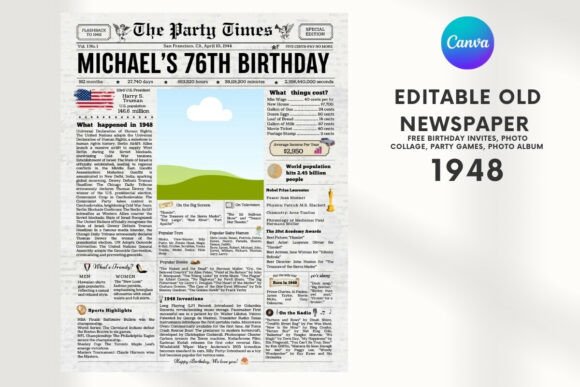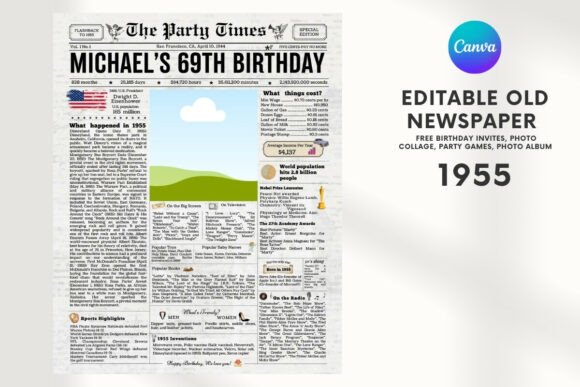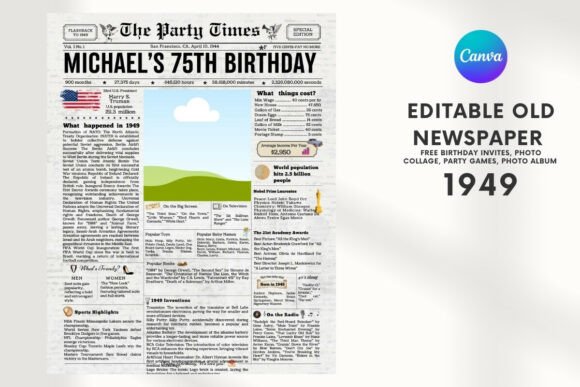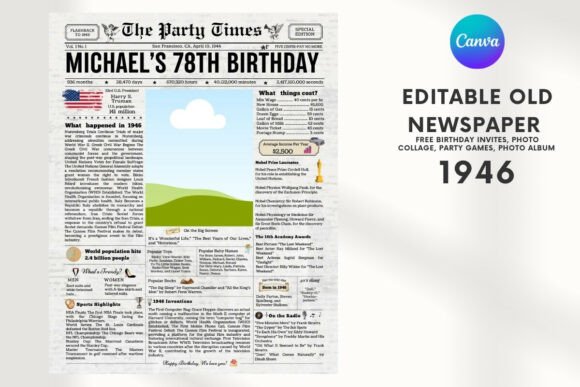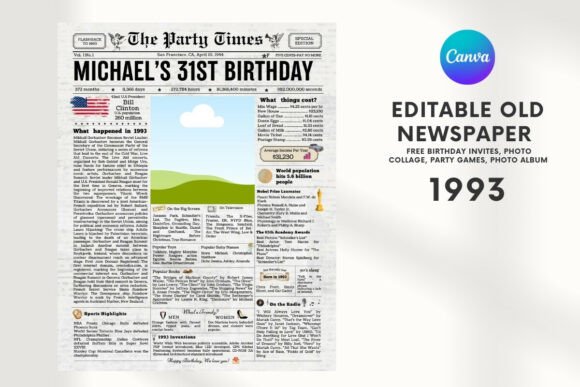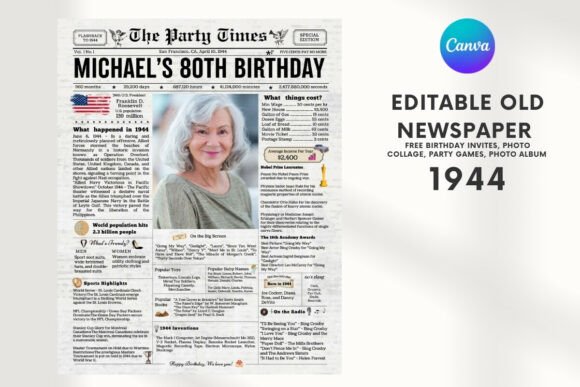
EDITABLE 1944 Birthday Vintage Newspaper
There’s something quietly powerful about holding a newspaper—yellowed at the edges, ink slightly softened by time—that tells a personal story instead of world news. The EDITABLE 1944 Birthday Vintage Newspaper taps into that resonance. It’s not a replica of a real 1944 paper; it’s a thoughtfully designed Canva template that borrows the aesthetic language of mid-century journalism—serif headlines, vintage borders, typewriter-style accents, and subtle paper texture—to frame someone’s life in a format that feels both nostalgic and intentional.
What makes it useful isn’t just its charm—it’s its flexibility. Every element is editable: headlines, bylines, pull quotes, photo placeholders, date lines, even the “weather report” or “society column.” You’re not locked into a rigid layout. You’re given structure with room to breathe—ideal for people who want design cohesion without sacrificing authenticity.
Creative Possibilities Beyond the Obvious
Most users start with the idea of a printed keepsake—a folded broadsheet placed beside the cake or tucked into a gift box. But the template’s real strength lies in how easily it adapts to different creative goals:
- Birthday invites with narrative depth: Instead of “Join us to celebrate Alex’s 40th!” try a front-page headline like “Local Visionary Marks Four Decades of Innovation, Wit, and Well-Timed Dad Jokes”, followed by “event details” styled as a society announcement.
- Memory-based infographics: Use the “Sports Section” to list “Life Wins” (first job, first home, marathon finish), the “Business Brief” for career highlights, and the “Arts & Culture” column for favorite books, songs, or travel moments.
- Interactive party elements: Print individual “articles” as table cards—each guest receives a short bio or fun fact about the celebrant, turning small talk into shared laughter.
- Digital storytelling: Export as PDF and embed in an email newsletter or birthday microsite. Add hyperlinks to photos, videos, or voice notes—keeping the vintage look while enabling modern interactivity.
Who Uses This—and Why It Fits Their Needs
A graphic designer might use the EDITABLE 1944 Birthday Vintage Newspaper as a client-facing deliverable—offering a premium, tactile alternative to standard digital invites. A teacher could adapt it for a student’s “All About Me” project, using columns to organize hobbies, family, goals, and favorite quotes. An entrepreneur launching a milestone anniversary campaign might rebrand the masthead as “The [Company Name] Chronicle, Vol. XII” and feature team spotlights, product milestones, and customer thank-yous in period-appropriate tone.
For educators and nonprofit communicators, the template supports inclusive storytelling: swap “Birthplace” for “Where I Feel Most Like Myself,” or turn the “Obituaries” section (often repurposed) into “Things I’ve Let Go Of—So I Could Grow.” These adaptations keep the format respectful, human-centered, and emotionally accurate—not just decorative.
Practical Tips for Strong Results
Clarity starts with intention. Before editing, ask: What feeling do I want this to evoke? Who is reading it—and what do they already know? A newspaper for a 90-year-old grandparent will prioritize legacy and warmth; one for a 25-year-old artist may lean into wit, irony, and visual experimentation.
To keep things organized:
- Start with the masthead and date line. Even if you change “1944” to the celebrant’s birth year, keeping the format consistent grounds the whole piece.
- Use hierarchy deliberately. Bold headlines should signal importance—not every fact needs top billing. Let subheads and body text carry supporting detail.
- Limit fonts to two max. Pair the vintage serif (built into the template) with a clean sans-serif for captions or contact info—no need to overdesign.
- Proofread out loud. Newspaper writing benefits from rhythm and brevity. If a sentence runs long, cut a word—or split it across two lines like a classic column.
Consistency doesn’t mean uniformity. One user printed three versions—one for childhood, one for adulthood, one for “future editions”—and displayed them chronologically on a wall. Another embedded QR codes next to “featured stories,” linking to video messages from friends. These aren’t gimmicks; they’re thoughtful extensions of the template’s core idea: telling a life story with care, clarity, and character.
Why This Works Where Other Templates Fall Short
Many birthday templates rely on glitter, confetti, or cartoonish fonts—fun for kids, less so for adults marking meaningful years. The EDITABLE 1944 Birthday Vintage Newspaper avoids trend-driven visuals. Its appeal is timeless because it’s rooted in format, not fad. The newspaper structure inherently suggests significance: front-page treatment for major life events, sidebars for quirks and asides, editorial tone for reflection.
It also scales well across formats. Need a single-page handout? Collapse sections into tight columns. Planning a slideshow? Export each “article” as a slide, keeping typography and spacing intact. Want social media snippets? Crop the “Headline + Photo” combo for Instagram posts—add a caption like “Today’s top story: Jane turns 52. Full edition available upon request.”
And because it lives in Canva, collaboration is frictionless. A family member can edit the “Family Tree” sidebar while a friend handles the “Entertainment Guide” (playlist recommendations, movie favorites, inside jokes). No design skills required—just shared attention to what matters.
At its best, the EDITABLE 1944 Birthday Vintage Newspaper isn’t about pretending it’s 1944. It’s about borrowing the weight and warmth of a format that once helped communities make sense of their world—and using it to honor the quiet, extraordinary act of living a life worth reporting on.