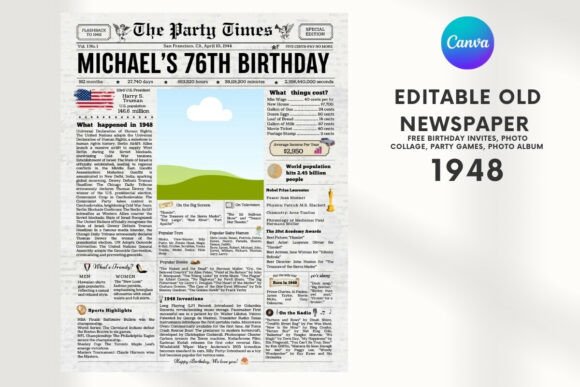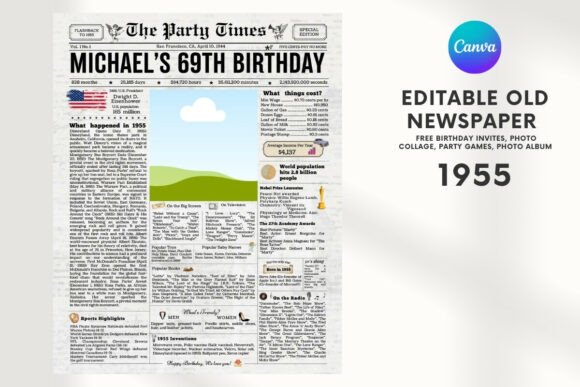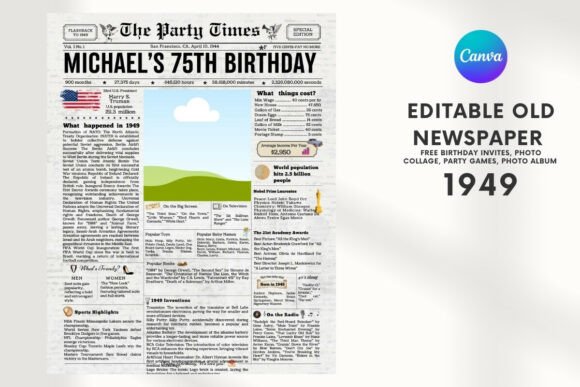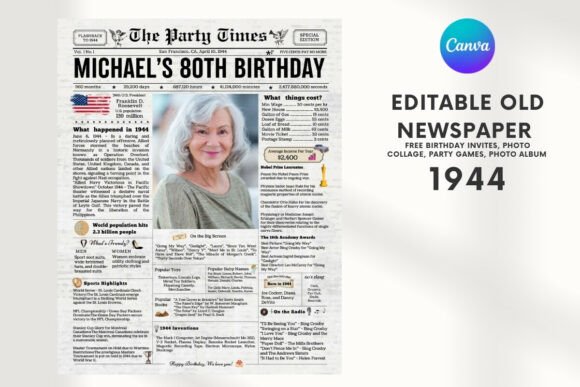
EDITABLE 1946 Birthday Vintage Newspaper
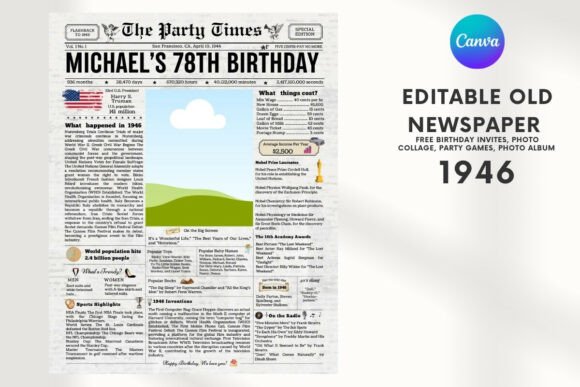
Imagine handing someone a crisp, sepia-toned newspaper dated the day they were born—complete with headlines about their life, not history. That’s the quiet magic of the EDITABLE 1946 Birthday Vintage Newspaper: a Canva-based digital template that transforms birthday celebrations into tactile, emotionally resonant experiences. It’s not just a design—it’s a storytelling framework rooted in nostalgia, built for flexibility, and engineered for real-world use.
This isn’t a static PDF or a one-size-fits-all graphic. It’s fully editable in Canva—meaning every headline, photo placeholder, byline, and “advert” section can be customized with your own text, fonts, colors, and images. The 1946 aesthetic isn’t just decorative; it’s intentional. That year evokes postwar optimism, typewriter authenticity, and mid-century charm—qualities that lend warmth and gravitas to modern milestones without feeling kitschy or forced.
Why This Template Fits Real Life—Not Just Pinterest Boards
Most birthday templates fall into two categories: overly cute or clinically minimal. The EDITABLE 1946 Birthday Vintage Newspaper bridges that gap. Its grid-based layout mimics actual broadsheet structure—front page banner, sidebar “classifieds,” “lifestyle” columns, even a mock weather report (“Sunny with bursts of laughter”). That structure does more than look authentic—it guides content creation. You’re not staring at a blank canvas; you’re filling meaningful sections with intention.
For example, the “Obituaries” section becomes a playful “In Memory of Childhood Summers” column. The “Sports Section” highlights personal victories—first bike ride, marathon finish, promotion announcement. Even the “Weather Forecast” can read: “Partly cloudy with high chances of cake.” These aren’t gimmicks—they’re cognitive anchors that help guests and recipients quickly connect with narrative beats.
Practical Uses Across Contexts
Personal & Family Celebrations: Ideal for milestone birthdays (30th, 50th, 75th), surprise parties, or intergenerational gatherings. Grandparents love seeing their life reframed as front-page news. Teens appreciate the irony—and the chance to curate their own “breaking stories.” One educator used it for her father’s 80th, embedding scanned letters, childhood photos, and quotes from relatives. Guests spent 20 minutes reading it—not scrolling.
Professional & Branding Use: Freelancers and small business owners integrate it into client onboarding or team recognition. A marketing agency gifted a “Company Milestone Edition” to a long-term client—featuring campaign wins as “front-page exclusives” and team shout-outs as “staff correspondents.” It stood out in a sea of e-cards and LinkedIn posts.
Educational & Creative Projects: Teachers use it for biography units, letting students research and present historical figures—or themselves—as 1940s-era newsmakers. Design students dissect its typography hierarchy and grid logic. Writers repurpose the layout for serialized storytelling or memoir drafts.
Digital Extensions: While designed for print, the template adapts well to digital sharing. Export as PDF for email invites, convert sections into Instagram carousels (“Today’s Top Stories: Your 42nd Year in Review”), or embed interactive elements using Canva’s link features—e.g., “Click the ‘Birth Announcement’ photo to watch the welcome video.”
What Makes It Work—Beyond the Aesthetic
First, it’s efficient. No wrestling with layers in Photoshop or learning InDesign. If you’ve used Canva before—even once—you can edit this in under 15 minutes. Text boxes are pre-sized, image frames auto-resize, and color palettes stay harmonious when you swap accent hues.
Second, it’s inclusive by design. There are no gendered illustrations or age-specific clichés. The tone is warm but neutral—equally fitting for a 25-year-old artist launching their first solo show or a retiree celebrating 60 years of marriage. You control the voice: witty, reverent, poetic, or deadpan.
Third, it communicates value. A printed newspaper signals effort. Unlike a digital invite that vanishes after opening, this lives on a shelf, gets passed around, and often ends up framed. That physicality reinforces emotional weight—especially for recipients who grew up with newspapers as daily ritual.
Things to Keep in Mind Before You Start
- Content matters more than decoration. Don’t overload every column. Leave white space. Let a single photo with a strong caption land harder than five cluttered sections.
- Test readability. Some vintage fonts look gorgeous at 24pt—but vanish at 10pt in body text. Stick to the recommended type pairings unless you’re confident adjusting line height and letter spacing.
- Think beyond the birthday. This template works for anniversaries, retirement send-offs, baby showers (as a “Birth Bulletin”), or even company founding days—just tweak the masthead date and tone.
- Printing tips: Use matte or uncoated 100–120 lb text paper for authenticity. Avoid glossy—it fights the vintage feel. For large groups, consider printing front and back on tabloid-size sheets and folding like a broadsheet.
One common oversight? Forgetting to personalize the “byline.” Instead of “Staff Writer,” try “Curated by [Name] with love and 27 years of inside jokes.” That tiny detail shifts the piece from generic to intimate.
The EDITABLE 1946 Birthday Vintage Newspaper succeeds because it respects both time and attention. It doesn’t ask you to invent a concept from scratch—it gives you scaffolding, then steps back. You bring the memories, relationships, and voice. It brings the structure, charm, and quiet authority of something that feels *found*, not fabricated.
And in an era where most communication is fleeting, that balance—between ease and meaning, between nostalgia and relevance—is rare. Whether you’re planning a quiet dinner or a 150-person gala, this template doesn’t just announce a birthday. It honors the person behind the date—thoughtfully, tangibly, and with unmistakable care.