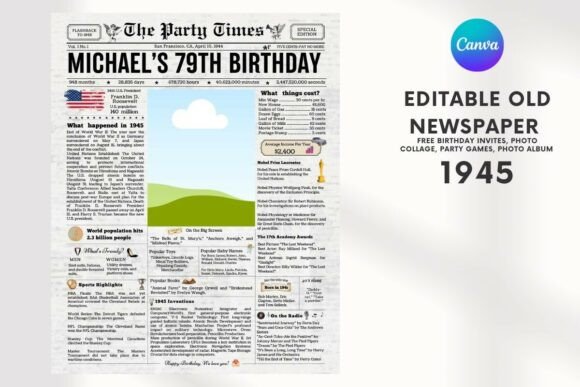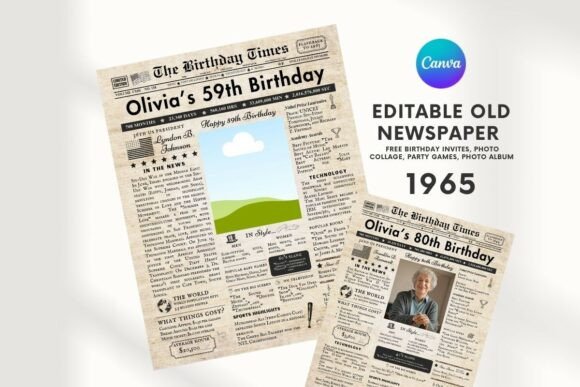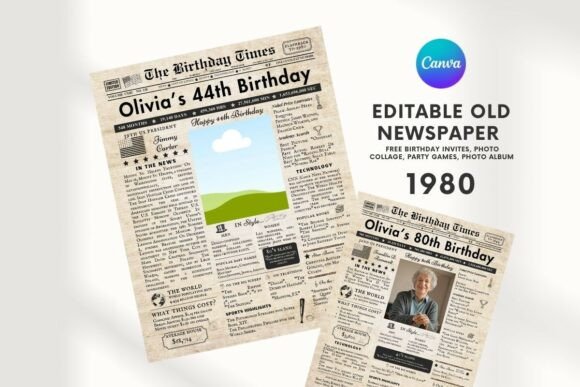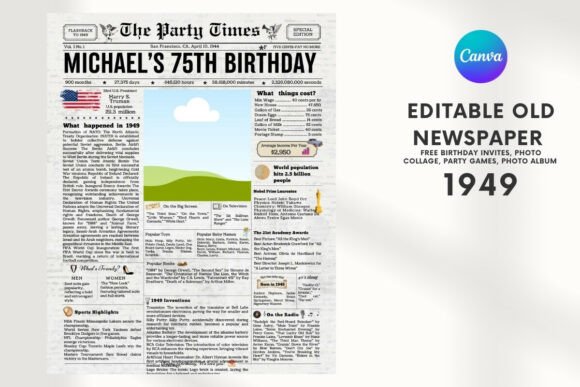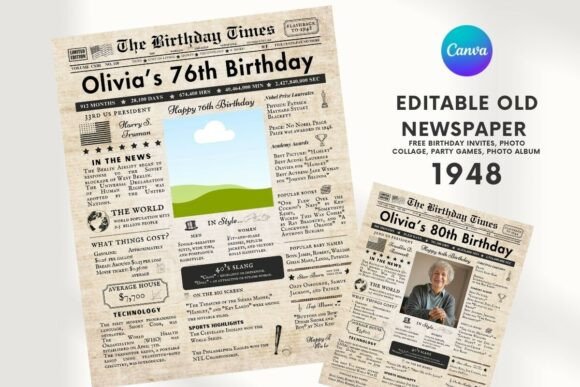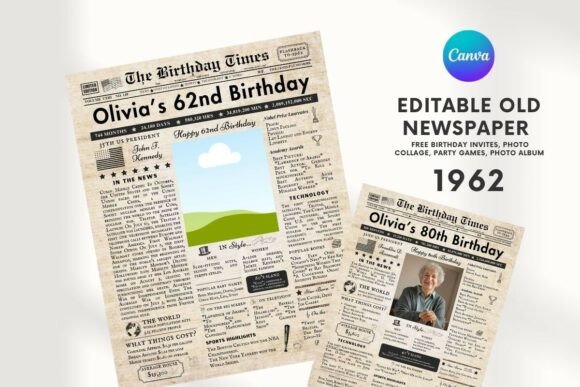
EDITABLE 62 Birthday Newspaper: A Thoughtful, Timeless Format for Milestone Storytelling
Turning 62 isn’t just another year—it’s a rich convergence of experience, resilience, and quiet wisdom. It’s the age where professional legacies are often fully realized, family trees have deepened across generations, and personal narratives carry layers of meaning that resonate far beyond a single celebration. In this context, generic party decorations or standard greeting cards rarely suffice. What’s needed is a format capable of honoring depth—not just duration. That’s where the EDITABLE 62 Birthday Newspaper distinguishes itself: not as a novelty prop, but as a narrative vessel designed with intentionality, flexibility, and emotional intelligence.
Why a Newspaper Format Works So Well at This Milestone
Newspapers—both historically and psychologically—signal importance. They’re how societies mark turning points: elections, discoveries, cultural shifts, and personal triumphs. Translating that gravitas into a birthday context creates immediate resonance. Unlike linear timelines or static photo collages, a newspaper layout invites scanning, pausing, and reflection. Readers naturally move from headline to byline to feature story—mirroring how memory itself operates: episodic, contextual, and layered with subtext.
At 62, life stories are rarely monolithic. There’s likely a career arc spanning multiple industries or roles; decades of evolving friendships; perhaps geographic relocations, parenting milestones, creative pursuits begun in midlife, or volunteer work that reshaped identity. A newspaper template accommodates this complexity organically—through dedicated sections like “Front Page Headlines,” “Local News (Family Updates),” “Arts & Culture (Hobbies & Passions),” and even “Weather Report (Current Life Outlook).” Each column becomes a respectful container—not for summarizing a life, but for spotlighting its texture.
How the EDITABLE 62 Birthday Newspaper Supports Real-World Use Cases
The strength of this resource lies in its adaptability across diverse scenarios—not just private gatherings, but also institutional and communal ones:
- Multi-Generational Family Reunions: Grandchildren can contribute illustrated “Junior Reporter” blurbs about shared memories—baking cookies, summer road trips, or learning to ride a bike. Parents and siblings add archival photos and handwritten quotes. The result isn’t just a keepsake; it’s an intergenerational dialogue made tangible.
- Retirement Celebrations: Colleagues draft lighthearted “Obituaries” (in the affectionate, humorous tradition of retirement roasts) celebrating the retiree’s legendary coffee runs or uncanny ability to fix the office printer. HR teams embed service milestones alongside heartfelt testimonials—transforming administrative data into human-centered storytelling.
- Educational Projects: Teachers use the framework for biographical units—students research and compose “front pages” on historical figures or community elders, practicing source evaluation, narrative structure, and ethical representation. The editable nature allows scaffolding: younger learners fill in sentence starters; older students write full op-eds or investigative features.
- Memory Care & Life Review Therapy: Clinicians and caregivers co-create simplified versions with individuals experiencing cognitive changes. Focusing on sensory-rich memories (“The Smell of Grandma’s Garden,” “The Sound of Saturday Morning Baseball”) anchors identity and fosters connection—even when chronological recall fades.
Design Integrity Meets Practical Flexibility
What makes the EDITABLE 62 Birthday Newspaper more than just a decorative overlay is its underlying design philosophy. Every element serves dual purposes: aesthetic cohesion and functional clarity. The masthead doesn’t just say “The Golden Years Gazette”—it includes space for the celebrant’s name and birth year, establishing immediate personal relevance. Datelines reference meaningful years (“Est. 1962,” “Vol. 41, No. 7”), reinforcing longevity without cliché.
Typography is deliberately accessible—not ornate script, but clean, high-contrast fonts that remain legible when printed at various sizes or viewed on screen. Photo placeholders follow journalistic conventions: captions describe context (“Dr. Aris Thorne receives the Community Health Award, 2018—her third such honor”), not just names and dates. Pull quotes are reserved for authentic voice: a line from a birthday letter, a lyric from a favorite song, or a piece of advice the person often shares.
This attention to detail matters because usability directly impacts emotional impact. A template that demands technical expertise alienates participants who aren’t designers. One that lacks structural guidance results in cluttered, overwhelming outputs. The balance here—achieved through Canva’s intuitive drag-and-drop interface paired with thoughtfully pre-structured sections—lowers the barrier to entry while preserving expressive range.
Customization That Honors Individuality, Not Just Aesthetics
“Editable” goes beyond changing colors or swapping photos. With the EDITABLE 62 Birthday Newspaper, users adjust narrative architecture:
- Add or suppress sections based on relevance—a lifelong traveler might expand “World Dispatches”; someone deeply rooted in one community may emphasize “Neighborhood Notes.”
- Modify tone per section: formal for career achievements, playful for childhood anecdotes, poetic for reflections on aging.
- Incorporate multimedia traces: QR codes linking to voice memos of loved ones sharing memories, or embedded links to playlists curated around the person’s life soundtrack.
- Translate content for bilingual households—running headlines in both English and Spanish, for instance, or including traditional blessings alongside modern well-wishes.
Crucially, editing never sacrifices coherence. The template maintains visual rhythm—consistent margins, balanced whitespace, logical information hierarchy—so even heavily customized versions feel professionally assembled. That consistency signals care. It tells the recipient: *This wasn’t thrown together. This was shaped, considered, and offered with attention.*
Considerations for Meaningful Implementation
While powerful, the format benefits from mindful application. Here’s what practitioners across fields observe:
- Avoid “Achievement Overload”: Listing every award, degree, or promotion risks flattening personality into a CV. Balance accolades with vulnerability—“First time baking sourdough during lockdown (it collapsed twice, then soared)” carries more warmth than “Master Baker, 2020.”
- Respect Privacy Boundaries: Not all milestones are public. A section titled “Personal Reflections” should be optional—and ideally contributed directly by the celebrant, not assumed by others.
- Account for Accessibility: When printing, use matte paper to reduce glare for readers with visual sensitivities. When sharing digitally, ensure alt text describes images meaningfully (“Photo of Mei Chen teaching pottery to teens at Oakwood Community Center, 2015”).
- Plan for Longevity: Use archival-quality ink and acid-free paper if intended as a physical heirloom. Digitally, save layered Canva files separately from flattened PDFs—preserving editability for future anniversaries.
From Moment to Memory: Why This Format Endures
Most birthday materials fade quickly—balloons deflate, cake is eaten, digital posts scroll away. But newspapers occupy a different psychological category. They’re artifacts of record. When someone receives their EDITABLE 62 Birthday Newspaper, they’re handed something that implies permanence: *Your life is newsworthy. Your story warrants documentation. You belong in the archive.*
That perception has measurable effects. Recipients report stronger feelings of being “seen”—not just celebrated. Families note renewed curiosity about each other’s pasts; adult children discover grandparents’ wartime childhoods or immigrant journeys through newly surfaced details. Educators find students more engaged when biographical work mirrors real-world publishing standards rather than worksheet formats.
Ultimately, the power isn’t in the template itself—but in how it redirects focus. Instead of asking “What party theme should we choose?” it invites “What chapters of this person’s story deserve front-page treatment?” It transforms celebration from performance into witness. And at 62, after six decades of showing up, adapting, creating, and caring—being witnessed, truly witnessed, may be the most resonant gift of all.
The EDITABLE 62 Birthday Newspaper doesn’t just mark time passed. It honors time lived—with nuance, dignity, and the quiet thrill of seeing one’s own life reflected back, thoughtfully composed, and deeply understood.