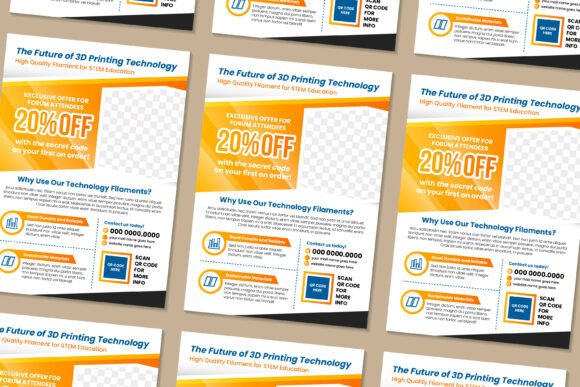
Future of 3D Vertical Flyer
If you're promoting a tech event, launching an educational workshop on additive manufacturing, or showcasing your 3D printing startup to investors — the Future of 3D Vertical Flyer gives you a clean, modern, and highly adaptable starting point. It’s not just another flyer template. It’s a thoughtfully designed vertical layout built specifically for communicating innovation in 3D printing — with clarity, visual impact, and professional polish.
What Makes This Flyer Different?
Unlike generic templates, this design anticipates how people actually engage with printed and digital promotional materials today. Its vertical orientation fits naturally on social media stories, digital kiosks, event signage, and printed posters — all while keeping key messages front and center. The bold black, blue, and yellow gradient isn’t just eye-catching; it subtly echoes themes of precision (blue), energy and optimism (yellow), and sophistication (black) — making it ideal for technology-focused messaging.
Every element is intentionally isolated on a crisp white background. That means no visual clutter — just focused attention on your content. Infographic-style sections let you highlight milestones in 3D printing evolution, material breakthroughs, or real-world applications like medical implants or sustainable architecture. There’s also dedicated photo space, so you can insert high-res images of printers in action, finished prototypes, or your team at work — without disrupting the layout’s balance.
Why It Works So Well for Real-World Use
This flyer shines because it bridges creativity and practicality. Whether you’re a small business owner explaining how 3D printing cuts prototyping costs, an educator preparing a classroom handout about future manufacturing careers, or a freelancer designing for a client in aerospace or healthcare — the structure supports your message without limiting your voice.
Take a local makerspace, for example. They could use the editable text fields to list upcoming workshops (“Intro to CAD & 3D Printing”, “Bioprinting Basics”), drop in a photo of their latest student project, and add a simple infographic showing how many hours faster 3D printing is compared to traditional mold-making. Or imagine a university department promoting its new additive manufacturing lab — they’d swap in their logo, adjust colors to match brand guidelines, and use the vector shapes to build custom icons representing research areas like “metal sintering” or “AI-driven design optimization.”
Designed for People Who Value Control and Quality
You’ll get everything you need in one download: AI and EPS files for full editing in Adobe Illustrator, SVG for web use and scaling without loss, and a high-resolution JPG for quick sharing or print previews. All graphics are 100% vector — meaning you can resize the entire flyer to billboard scale or shrink it down for a handout, and it will stay razor-sharp. At 300 DPI, it meets professional print standards right out of the box.
The file is well organized — layers are named clearly, color swatches are grouped, and text remains fully editable. No locked assets or flattened effects. You’re not stuck with preset phrases or fixed layouts. Want to shift the gradient direction? Swap yellow for teal? Move the photo block above the infographic? Go ahead — it’s built to adapt, not constrain.
Who Benefits Most From This Template?
- Beginners who want a polished look without mastering complex design software — just replace placeholder text and drop in your image.
- Marketers needing consistent, on-brand visuals across campaigns — especially when targeting tech-savvy audiences or STEM communities.
- Educators building course flyers, conference summaries, or student project showcases that reflect forward-thinking pedagogy.
- Entrepreneurs pitching hardware startups, service bureaus, or consulting firms where credibility and clarity matter more than flashy gimmicks.
- Freelancers who juggle tight deadlines — this saves hours on layout and lets them focus on strategy and storytelling.
Things to Keep in Mind Before You Start
While the Future of 3D Vertical Flyer is flexible, a few smart choices early on make a big difference. First, think about your audience’s expectations: technical professionals may appreciate data points and specific terminology (“selective laser sintering”, “multi-material jetting”), while general audiences respond better to clear benefits (“print custom prosthetics in days, not months”).
Second, consider where the flyer will live. If it’s going to be shared digitally, keep file size in mind — SVG works beautifully for web, while JPG is great for email attachments. For physical printing, double-check bleed and margin settings in the AI or EPS version, especially if your printer requires extra space around edges.
And finally, remember that strong visuals support, but don’t replace, strong messaging. The infographic elements are meant to clarify — not overwhelm. A single well-placed statistic (“78% of manufacturers now use 3D printing for rapid tooling”) paired with a clean icon says more than three dense paragraphs.
A Template That Grows With Your Ideas
This isn’t a static design frozen in time. It’s built to evolve alongside your goals — whether you’re announcing a new filament line, illustrating ethical considerations in bioprinting, or mapping how 3D printing intersects with AI and sustainability. The gradient color scheme feels contemporary but not trendy, so it won’t look dated next year. The white background ensures readability in any lighting condition, from trade show booths to classroom projectors.
Most importantly, it respects your time and expertise. You don’t need to be a designer to communicate effectively — you just need tools that get out of your way. With editable shapes, intuitive layering, and multiple format options, the Future of 3D Vertical Flyer helps you spend less time wrestling with alignment and more time connecting with people who care about what’s next in manufacturing, medicine, education, and beyond.