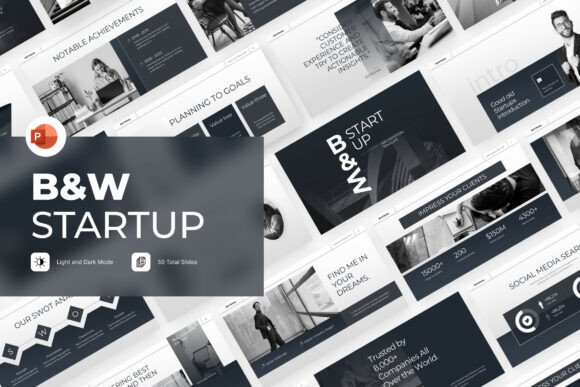
B W Startup PowerPoint Template
When you're launching a new venture, refining a pitch, or aligning internal stakeholders around a strategic shift, your presentation isn’t just a delivery tool—it’s a living extension of your brand’s clarity, discipline, and intent. The B W Startup PowerPoint Template is built for that moment: not as a decorative shell, but as a structured, consistent, and deeply practical framework for communicating progress, decisions, and vision across every phase of business development.
This isn’t another generic deck with placeholder text and overused icons. It’s a purpose-built system—50 unique slides, 90 XML files, and dual light/dark modes—designed to support real work: validating assumptions before launch, visualizing customer journey maps during product development, benchmarking against competitors mid-cycle, or presenting quarterly outcomes with narrative cohesion. Its strength lies in how it integrates into existing workflows—not by replacing them, but by elevating consistency and reducing friction at key handoff points.
How It Fits Into Your Real-World Process
Think of the B W Startup PowerPoint Template as a connective tissue—not a starting point or an endpoint, but a reliable interface between planning, execution, and reflection. For example:
- Before a project starts: Use the “Vision & Scope” and “Stakeholder Alignment” slides to draft shared definitions of success, map decision rights, and clarify constraints—all before writing a single line of code or signing a contract.
- During active development: Leverage the handmade infographics—like funnel breakdowns, timeline overlays, or competitive heatmaps—to translate raw data into digestible insights during sprint reviews or investor updates. Because each slide is fully customizable (colors, fonts, layout), you maintain brand integrity without sacrificing speed.
- After delivery or launch: Repurpose the “Results & Learnings” and “Next Horizon” slides to synthesize outcomes—not just metrics, but qualitative takeaways—and frame what comes next with grounded realism, not vague ambition.
This rhythm—plan → execute → reflect—mirrors how high-performing teams actually operate. The template doesn’t impose rigidity; instead, it provides scaffolding so you spend less time formatting and more time thinking critically about what the data means, who needs to hear it, and how it connects to broader goals.
Integration With Tools You Already Use
The B W Startup PowerPoint Template works best when treated as part of a larger toolkit—not in isolation. It complements, rather than competes with, platforms like Notion (for research notes and task tracking), Figma (for wireframes and user flows), Excel or Google Sheets (for financial modeling), and even CRM dashboards (for pipeline snapshots).
Here’s how that looks in practice:
- You build a go-to-market forecast in Excel → copy key charts into the “Growth Trajectory” slide, preserving axis labels and color logic using the custom Office theme palette.
- You map user pain points in Figma → export annotated screenshots and drop them directly into the “Problem-Solution Fit” layout, which already includes callout zones and contrast-safe backgrounds.
- You capture stakeholder feedback in Notion → convert recurring themes into concise bullet points inside the “Validation Summary” slide, using the built-in typography hierarchy to signal priority and confidence level.
No plugin or conversion step is required. Because it’s native PowerPoint (.pptx), it opens instantly, edits reliably, and exports cleanly to PDF or video—critical for sharing with legal teams, remote collaborators, or non-Microsoft environments. The included XML files also allow deeper customization for users comfortable editing theme definitions, ensuring long-term scalability across departments or campaigns.
Practical Implementation Tips
Getting consistent value from the B W Startup PowerPoint Template isn’t about using every slide—it’s about identifying your highest-leverage touchpoints and standardizing there first. Start small:
- Pick two recurring use cases. Examples: investor update decks and internal sprint retrospectives. Build versions of those using only the relevant slides—no more, no less.
- Lock your brand colors early. Use the provided XML files to define primary/secondary palettes once, then apply them globally. This avoids version drift across team members and ensures printed handouts match screen presentations.
- Adopt the light/dark toggle intentionally. Use light mode for daytime client meetings and dark mode for evening workshops or projector-heavy rooms—no manual background swaps needed.
- Store assets centrally. Since stock images aren’t included, create a shared folder with approved icons, logos, and photo sources. Tag each asset with its intended slide type (e.g., “timeline-icon,” “competitor-logo”) so anyone on the team can assemble a polished deck in under 30 minutes.
Over time, this builds muscle memory—not just for design, but for communication discipline. Teams begin to anticipate which slide answers which question, making decks faster to build, easier to critique, and more persuasive to audiences who’ve seen too many unfocused narratives.
Long-Term Usability and Quality Control
A template’s real test isn’t its first use—it’s whether it holds up after six months of revisions, three leadership changes, and dozens of audience types. The B W Startup PowerPoint Template supports longevity through intentional constraints: no auto-layout surprises, no hidden animations, no embedded fonts that break on other machines. Everything is editable, traceable, and reversible.
That predictability enables quality control at scale. Marketing can review a sales deck in under five minutes because they know where the CTA lives, where assumptions are called out, and where risk disclosures appear. Executives can scan a strategy update and immediately locate the “Key Dependencies” and “Timeline Confidence” indicators—no hunting through dense paragraphs.
And because RRGraph Design has supported over 1,000 global companies, the template reflects patterns observed across industries: what makes a funding ask credible, how technical teams respond to roadmap visuals, why educators prefer certain data layouts for student-facing materials. It’s not theoretical—it’s field-tested.
Who Benefits Most—and How
If you’re an entrepreneur building your first pitch deck, the B W Startup PowerPoint Template removes guesswork about structure and tone—letting you focus energy on your story, not slide transitions. If you’re a freelancer delivering monthly reports to clients, it gives you a repeatable format that signals professionalism without requiring design expertise. If you’re an educator mapping curriculum rollout or a nonprofit lead preparing a grant renewal package, the holistic brand touchpoints ensure your mission stays visually anchored—even when content shifts.
What ties these users together isn’t their role, but their need: to communicate complex ideas with precision, adapt quickly to feedback, and maintain coherence across formats and timelines. The template doesn’t promise perfection—it promises reliability. And in fast-moving, resource-constrained environments, reliability is the foundation everything else rests on.