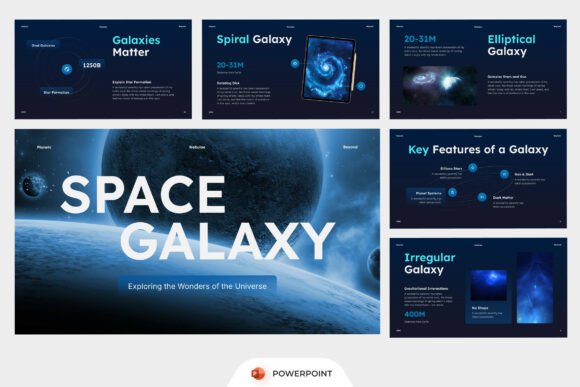
Galaxy Space PowerPoint: A Futuristic Template for Stellar Science Presentations
Imagine launching a classroom lesson on black holes—not with static diagrams and bullet points, but with a dynamic, star-dusted slide that pulls students into the spiral arms of the Milky Way. Or presenting cutting-edge space mission data at an educational seminar using animated planetary orbits and deep-space gradients that make complex astrophysics feel intuitive. That’s the power of Galaxy Space PowerPoint: a purpose-built, futuristic educational presentation template designed specifically for astronomy topics, space exploration, science projects, and cosmic storytelling.
What Is Galaxy Space PowerPoint—and Why Does It Matter?
At its core, Galaxy Space PowerPoint is more than just a collection of pretty slides—it’s a pedagogical tool engineered to enhance clarity, engagement, and retention in science communication. Unlike generic templates, it’s grounded in real-world educational needs: teachers preparing astronomy lessons, university students designing research defenses, museum educators crafting interactive exhibits, or STEM outreach coordinators developing public-facing universe exploration campaigns.
This isn’t a “space-themed” design slapped onto standard layouts. Every element—from the galaxy-inspired background textures and nebula color palettes to the planetary infographic sections and universe overview timelines—has been intentionally crafted to support scientific literacy. The result? Presentations that don’t just look impressive but actively reinforce learning through visual coherence and thematic consistency.
How It Works: Designed for Real-World Use
Galaxy Space PowerPoint comes as a fully editable PowerPoint file (.pptx) built in the industry-standard 16:9 widescreen ratio, ensuring crisp display on modern projectors, interactive whiteboards, and virtual meeting platforms like Zoom or Microsoft Teams. Its architecture prioritizes usability without sacrificing sophistication:
- Fully editable slides—text, icons, charts, and layout structures can be modified instantly, no design skills required;
- Included free font—a clean, space-age sans-serif typeface optimized for legibility and thematic resonance;
- Intuitive customization—color schemes shift globally with one click; planetary infographics update automatically when you change values;
- Comprehensive help guide—step-by-step instructions for beginners and pro tips for advanced users (e.g., animating orbital paths or embedding real-time NASA data feeds);
- Zero stock image dependencies—all visuals are vector-based or embedded shapes, meaning your presentation stays portable and license-compliant.
Note: While all graphic elements inside the template are original and editable, external stock photography is not included—keeping the package lightweight, ethical, and copyright-safe for academic and nonprofit use.
Bridging Education and Innovation
In today’s classrooms and lecture halls, effective science communication faces two persistent challenges: information overload and cognitive disengagement. Students often struggle to connect abstract concepts—like gravitational lensing or exoplanet atmospheric spectroscopy—with tangible mental models. Galaxy Space PowerPoint addresses this by transforming data into narrative.
For example, instead of listing Kepler mission statistics on a plain slide, educators can use the universe overview timeline to visually trace humanity’s journey from Galileo’s telescope to James Webb’s infrared gaze—complete with milestone icons, era-specific color tones, and expandable footnotes. Similarly, a high school physics class studying orbital mechanics can animate a simplified Earth-Moon system directly within the template’s planetary infographic section, reinforcing Newtonian principles through motion rather than memorization.
This approach aligns with evidence-based teaching strategies like multimodal learning and spatial scaffolding, where visual structure supports conceptual understanding. It also meets growing institutional expectations for inclusive, accessible design—offering high-contrast modes, clear typography hierarchy, and logical slide sequencing that benefits neurodiverse learners and English language learners alike.
More Than Just Slides: A Tool for Creativity and Professional Growth
While educators are primary users, Galaxy Space PowerPoint extends its value across multiple domains:
- Science Exhibitions & Museums: Curators use its modular slide system to build rotating displays—swap out content for new missions (e.g., Artemis III updates or Europa Clipper findings) without redesigning entire decks.
- University Research Defense: Graduate students in astrophysics or aerospace engineering leverage its space research visuals to contextualize simulations, telescope data, or propulsion models—making technical work accessible to interdisciplinary committees.
- STEM Outreach Campaigns: Nonprofits and space agencies use its deep-space themed compositions to craft compelling grant proposals, donor briefings, or public awareness materials that balance wonder with scientific rigor.
- Student-Led Projects: From middle-school solar system dioramas to college capstone presentations on dark matter detection, learners gain confidence by working with professional-grade tools—not clipart-filled placeholders.
Importantly, Galaxy Space PowerPoint does not require advanced software. There’s no need for Adobe After Effects, Canva Pro subscriptions, or coding knowledge. Everything runs natively in Microsoft PowerPoint—making it both future-proof and universally deployable across schools, libraries, and community centers with limited tech budgets.
Dispelling Common Misconceptions
A few assumptions often surface about specialized presentation templates like this one—and clarifying them helps users get the most value:
- Misconception: “It’s only for astronomy teachers.”
Reality: Its adaptable framework works equally well for environmental science (comparing Earth systems to exoplanet biospheres), computer science (visualizing distributed computing across satellite networks), or even philosophy classes exploring cosmic ethics and planetary stewardship. - Misconception: “Customizing takes hours.”
Reality: With pre-built master slides and consistent style guides, updating a full 15-slide deck typically takes under 20 minutes—even for first-time users. - Misconception: “It sacrifices accuracy for aesthetics.”
Reality: All planetary scale ratios, constellation placements, and spectral color mappings follow current IAU and NASA standards—ensuring visual fidelity matches scientific integrity.
Why This Template Fits Modern Educational Needs
Educational technology has evolved far beyond PDF handouts and overhead projectors—but many presentation tools haven’t kept pace. Galaxy Space PowerPoint fills a critical gap: it merges design excellence, pedagogical intentionality, and technical accessibility. In an era where attention spans shrink and misinformation spreads rapidly, giving educators and communicators a trusted, accurate, and inspiring medium matters more than ever.
It also reflects broader shifts in how we understand learning itself—not as passive reception, but as active participation in meaning-making. When a slide doesn’t just state “the Sun is 93 million miles away,” but invites viewers to zoom from Earth’s surface through the heliosphere to the Oort Cloud, it transforms facts into experiences.
And because it’s built for longevity—not viral trends—the template supports long-term curriculum development. Teachers report reusing and adapting their Galaxy Space decks year after year, adding new discoveries while preserving proven instructional flows.
Get Started—Without the Learning Curve
Whether you’re introducing lunar phases to fifth graders or briefing policymakers on asteroid mining regulations, Galaxy Space PowerPoint offers a launchpad—not a limitation. Its included help guide files walk you through everything from changing gradient nebula backgrounds to exporting accessible PDF versions with alt-text-ready structure. No jargon. No gatekeeping. Just clarity, creativity, and cosmic curiosity—ready to present.
In a world increasingly shaped by space-based technologies—from GPS navigation to climate monitoring satellites—understanding our place in the universe isn’t optional. It’s foundational. And with Galaxy Space PowerPoint, that understanding doesn’t begin with textbooks alone. It begins with a single, stunning slide—and the story it helps you tell.