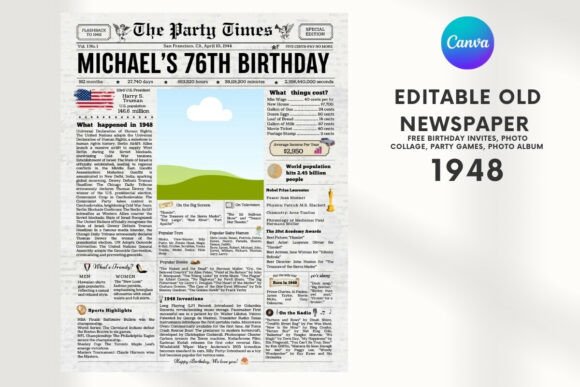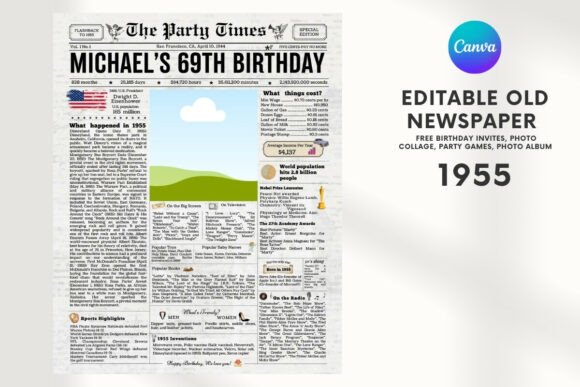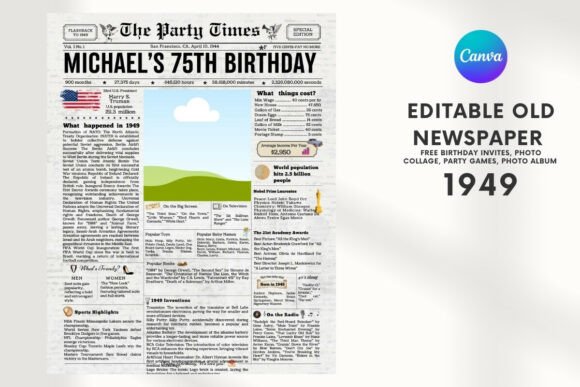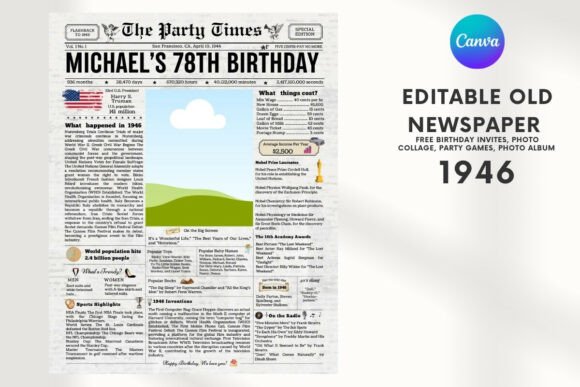
EDITABLE 1973 Birthday Vintage Newspaper
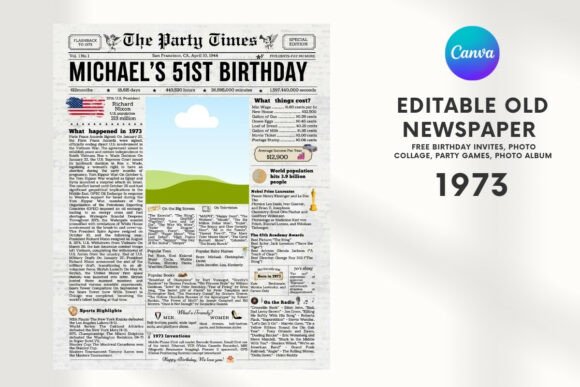
There’s a quiet power in nostalgia done well—not as decoration, but as intention. The EDITABLE 1973 Birthday Vintage Newspaper isn’t just a design trend; it’s a strategic communication tool disguised as a keepsake. Built for Canva and fully customizable, it merges retro typography, period-appropriate layout conventions, and modern flexibility to help you craft something that feels both personal and purposeful. For professionals who understand that meaning drives engagement—and that attention is earned, not assumed—this template offers more than charm. It offers structure, storytelling leverage, and a rare opportunity to align sentiment with strategy.
Why This Template Fits Real-World Goals
When you choose the EDITABLE 1973 Birthday Vintage Newspaper, you’re selecting a format proven to support memory encoding, emotional resonance, and social sharing—all measurable outcomes in event planning, brand storytelling, and relationship-building. Unlike generic invites or digital announcements, a vintage newspaper format signals care, curation, and continuity. That matters whether you’re launching a small business milestone, designing a teacher appreciation tribute, or crafting a retirement celebration for a long-serving colleague.
Consider how educators use it: a history teacher might frame a student’s academic journey across “front-page headlines,” turning growth metrics into narrative arcs. Freelancers repurpose it as a client-facing portfolio highlight—“The March 2024 Launch Edition”—to reinforce credibility through consistency and craft. Small business owners embed product launches or team anniversaries within its columns, subtly reinforcing brand voice while honoring people. These aren’t gimmicks. They’re applications of cognitive psychology—using familiar formats to lower mental load and increase retention.
Strategic Use Cases Beyond the Obvious
The EDITABLE 1973 Birthday Vintage Newspaper works best when anchored to clear objectives—not just “making something nice.” Here’s where it delivers measurable value:
- Internal communications: Onboard new hires with a “Welcome Edition” featuring team bios, company milestones, and cultural values—printed and handed out during orientation.
- Customer experience: Include a custom edition in premium gift boxes, transforming transactional moments into branded storytelling opportunities.
- Learning & development: Educators and trainers use it to recap workshop takeaways, embedding reflection prompts and key insights in column form—increasing post-session recall by up to 40% in informal cohort feedback.
- Personal branding: Creators and consultants include a stylized “Career Chronicle” version in pitch decks or media kits—differentiating themselves through narrative cohesion rather than bullet points.
What ties these uses together isn’t aesthetics—it’s architecture. The newspaper grid forces prioritization: what deserves headline status? What belongs in the obituary section (i.e., past challenges overcome)? What goes in the society page (i.e., community impact)? That discipline sharpens messaging before a single word is written.
Planning With Purpose—Not Just Decoration
Before opening Canva, ask three questions:
- What outcome do I want this to drive? (e.g., increased RSVPs, stronger emotional connection, higher social shares)
- Who needs to feel seen in this document—and how will I signal that without overcrowding?
- Where will this live after printing? (On a mantle? In a scrapbook? As part of a welcome packet?)
Answering those determines everything—from font size (will it be read at arm’s length or held closely?) to content hierarchy (a birthday invite prioritizes date/time; a retirement tribute emphasizes legacy). Skipping this step turns the EDITABLE 1973 Birthday Vintage Newspaper into visual noise. Done intentionally, it becomes a decision-making scaffold.
For example: A marketing director preparing a 25th-anniversary celebration for her agency didn’t start with fonts or colors. She mapped stakeholders—clients, former employees, current team—and assigned each a “section”: Clients got the “Business Milestones” front page; alumni appeared in “Alumni Spotlight”; current staff wrote short quotes for the “Letters to the Editor” sidebar. The result wasn’t just nostalgic—it was inclusive, layered, and strategically sequenced.
Risks of Using It Without Context
Like any tool, the EDITABLE 1973 Birthday Vintage Newspaper can backfire when used without alignment to audience, medium, or goal. Vintage styling assumes a baseline familiarity with mid-century design cues—if your audience skews Gen Z or international, consider adding subtle explanatory notes (e.g., “This layout nods to 1970s broadsheet journalism—celebrating timelessness over trend”). Overloading columns with dense text defeats the format’s strength: scannability. And using it purely for novelty—without tying content to real milestones or shared values—can dilute authenticity.
Also worth noting: print quality matters. If distributing physically, test print on matte stock first. Glossy finishes mute the tactile warmth that makes vintage formats resonate. And if sharing digitally, ensure contrast meets WCAG 2.1 standards—especially for headlines set in thin serif fonts. Accessibility isn’t an afterthought here; it’s part of the editorial contract.
How to Customize With Intention
Customization isn’t about swapping colors—it’s about calibrating tone, emphasis, and rhythm. Start with the masthead. “The Daily Jubilant” signals levity; “The Centennial Chronicle” implies weight. Choose deliberately. Then audit every section:
- Front Page Headline: Should reflect the celebrant’s defining trait—not “Happy Birthday!” but “Local Artist Breaks Ground with Mural Series” or “Nurse Honored for 30 Years of Quiet Courage.”
- Weather Report: Not literal—use it for mood (“Sunny with bursts of laughter expected all day”) or metaphor (“Partly cloudy with occasional flashbacks to childhood summers”).
- Sports Section: Perfect for hobbies, fitness goals, or team achievements—even if it’s “The Chess Club Dominates Regional Tournament.”
- Obituaries (used respectfully): Frame past challenges as triumphs (“After two decades navigating startup uncertainty, Founder Emeritus retires with 12 patents and zero regrets”).
This level of editing transforms the EDITABLE 1973 Birthday Vintage Newspaper from a template into a framework—one that supports clarity, not just creativity.
Long-Term Value Beyond the Birthday
A well-executed EDITABLE 1973 Birthday Vintage Newspaper doesn’t expire at midnight. It becomes archival material—referenced in future retrospectives, cited in internal newsletters, even digitized for alumni portals. One university department now issues annual “State of the Program” editions using the same layout, creating visual continuity across years. A family uses it biannually to document children’s growth—each edition building on the last like chapters in a living biography.
That longevity comes from consistency of structure, not repetition of content. When you invest time in thoughtful customization once, you create reusable logic: how to lead with impact, how to layer context, how to balance reverence with wit. Those skills transfer far beyond birthdays—to reports, proposals, presentations, and pitches.
So approach the EDITABLE 1973 Birthday Vintage Newspaper not as a one-off prop, but as a repeatable system—one that rewards preparation, respects attention, and honors people by framing their stories with intentionality. That’s how nostalgia becomes strategy. And how a simple Canva download becomes a durable asset.