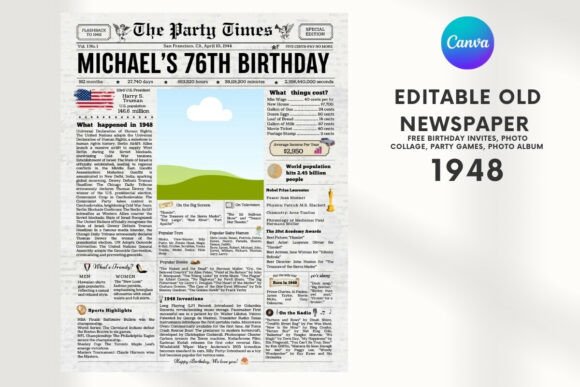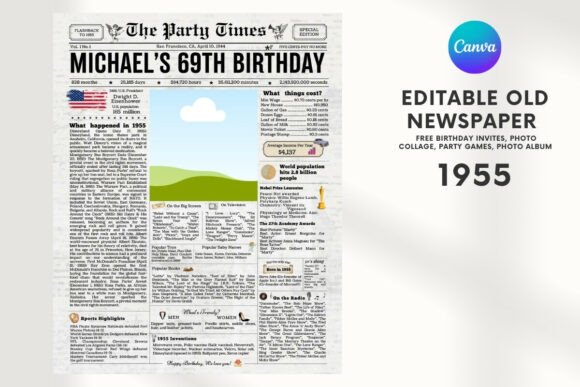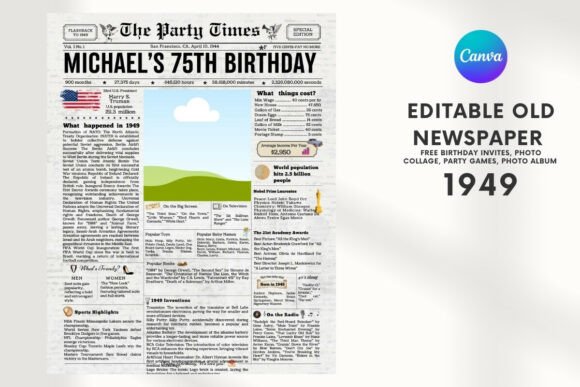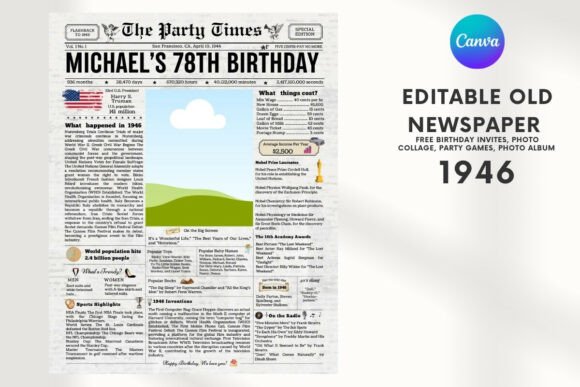
EDITABLE 1991 Birthday Vintage Newspaper
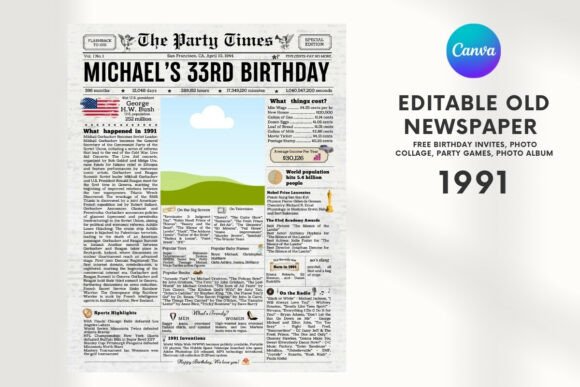
Imagine flipping through a weathered front page—not of world events, but of someone’s life: their first steps beside a headline reading “Local Toddler Takes Historic Leap,” a sports section recapping childhood soccer triumphs, and an obituary-style “In Memory of Sleepovers Past.” That’s the quiet magic of the EDITABLE 1991 Birthday Vintage Newspaper: a thoughtfully designed Canva template that transforms personal history into tactile, nostalgic storytelling. It’s not just a design—it’s a time capsule you build yourself, grounded in the warm, sepia-toned authenticity of early-’90s print media, yet fully adaptable to today’s digital-first workflows.
Why 1991? And Why Now?
The year 1991 carries subtle resonance for many celebrating milestone birthdays—especially those turning 33–34 in 2024. It predates the internet’s mainstream arrival, evoking a slower, more intentional pace of communication. Think rotary phones, handwritten letters, newspaper delivery boys on bikes, and headlines set in bold serif type. That aesthetic isn’t about escapism; it’s about contrast. In an age of fleeting social media posts and algorithm-driven feeds, a physical birthday newspaper offers something rare: permanence, intentionality, and human scale. Users aren’t chasing retro for irony—they’re choosing it for meaning.
This aligns with broader shifts in how people mark milestones. According to recent surveys, over 68% of adults aged 25–45 now prioritize *experiential* and *personalized* celebrations over generic gifts or mass-produced decor. A birthday isn’t just a date—it’s a narrative anchor. The EDITABLE 1991 Birthday Vintage Newspaper meets that need by giving creators full control over tone, structure, and emotional texture—without requiring design expertise or hours of layout work.
More Than a Template: A Workflow Companion
What sets this apart from standard Canva templates is its deliberate scaffolding. It’s not a blank canvas disguised as vintage—it’s built with functional sections: “Front Page Headlines” (for major life moments), “Lifestyle Section” (hobbies, quirks, favorite meals), “Classifieds” (funny “wanted” ads like “One Reliable Co-Pizza-Eater, Must Love Bad Jokes”), and even a mock “Weather Report” (“Sunny with a 100% chance of cake”). Each element invites reflection—not just decoration.
For professionals and small business owners, this translates to practical utility. A freelance photographer might use it as a client gift after a milestone session—embedding behind-the-scenes stories alongside printed proofs. An educator could adapt it for a student-led “life journalism” project, teaching research, narrative framing, and visual hierarchy. A marketing manager might repurpose the layout for an internal team celebration, reinforcing culture through shared, human-centered storytelling.
How Real People Are Using It—Without Overcomplicating Things
Take Maya, a 37-year-old content strategist in Portland. She used the EDITABLE 1991 Birthday Vintage Newspaper to celebrate her father’s 70th. She sourced childhood photos, interviewed relatives for anecdotes, and included a “Business Section” parodying his decades-long career in hardware retail (“Owner Opens Third Store Amidst Strong Demand for Wrenches”). Printed on matte newsprint and folded with twine, it sat beside the cake—not as decor, but as conversation fuel. Guests spent over an hour reading aloud favorite lines.
Then there’s Javier, who runs a micro-bakery in Austin. He adapted the template into a “Grand Opening Gazette” for his shop’s first anniversary—swapping birthdates for founding dates, “childhood pets” for signature sourdough starters, and “school report cards” for early customer reviews. It doubled as both celebration piece and subtle brand storytelling tool—no jargon, no sales pitch, just warmth and specificity.
These aren’t outliers. They reflect a growing preference for tools that support *meaningful customization*, not just visual polish. The EDITABLE 1991 Birthday Vintage Newspaper succeeds because it respects users’ time (Canva’s drag-and-drop interface means edits take minutes, not days) while honoring the weight of what they’re commemorating.
Nostalgia Done Right: Authentic, Not Generic
Nostalgia is often misapplied—reduced to filters, fonts, or stock imagery that feels hollow. This template avoids that trap by anchoring its aesthetic in real historical detail: justified text blocks, subtle halftone textures, period-appropriate type pairings (think Times New Roman headlines with Courier New body copy), and even simulated paper grain. But crucially, none of it is locked in place. You can swap out the 1991 masthead for “The Daily Jubilation, Vol. I, Issue 1” or replace the weather column with a Spotify playlist QR code. The vintage layer serves the story—not the other way around.
That balance matters. A 2023 Adobe Creative Trends report found that audiences respond most strongly to nostalgia when it’s *contextualized*, not copied. They want to feel seen—not reminded of a decade they didn’t live through. The template achieves this by treating 1991 not as a costume, but as a stylistic framework flexible enough to hold deeply personal, contemporary content.
Practical Tips for Getting Started
- Start with one section—not the whole paper. Draft the “Front Page Headline” first: What’s the most resonant moment to lead with? A graduation? A move across the country? A quiet act of courage? Let that set the tone.
- Use real artifacts. Scan a childhood report card, a concert ticket stub, or a grocery receipt from a meaningful day. Even low-res scans add texture and truth.
- Write like you speak. Avoid overly formal language—even in mock “obituaries” or “editorials.” Humor, warmth, and specificity land harder than polished prose.
- Print intentionally. Matte or uncoated paper enhances the vintage feel. If sharing digitally, export as PDF with embedded fonts—and consider adding subtle page-turn animations for screen viewing.
Beyond Birthdays: Where This Template Fits in a Changing Creative Landscape
While designed for birthdays, the underlying structure supports broader creative needs. Educators use similar frameworks to teach media literacy and narrative nonfiction. HR teams adapt them for onboarding kits (“Welcome to Our Newsroom: Meet Your New Colleagues”). Even therapists have piloted versions as reflective tools in life-review exercises with older adults.
What’s consistent across these uses is a demand for tools that are both emotionally intelligent and technically accessible. The EDITABLE 1991 Birthday Vintage Newspaper reflects a larger shift: away from one-size-fits-all digital products, toward modular, human-centered assets that empower—not overwhelm. It doesn’t ask users to become designers. It asks them to become storytellers—and gives them the right pen, paper, and permission to begin.
A Last Thought on Tangibility
In a world where so much of our lives lives in the cloud, holding a printed newspaper—even one created in minutes on a laptop—carries quiet power. It resists deletion. It invites slow reading. It fits in a drawer, on a shelf, or tucked inside a greeting card. It says: This person mattered enough to make something that lasts.
That’s why the EDITABLE 1991 Birthday Vintage Newspaper isn’t just another Canva download. It’s a small, deliberate act of attention—one that meets modern expectations for speed and flexibility, without sacrificing depth, warmth, or staying power.